Andrew began his classroom life as a high-school English teacher in 1988, and has been working in or near schools ever since. In 2008, Andrew began exploring the practical application of psychology and neuroscience in his classroom. In 2011, he earned his M. Ed. from the “Mind, Brain, Education” program at Harvard University. As President of “Translate the Brain,” Andrew now works with teachers, students, administrators, and parents to make learning easier and teaching more effective. He has presented at schools and workshops across the country; he also serves as an adviser to several organizations, including “The People’s Science.”
Andrew is the author of "Learning Begins: The Science of Working Memory and Attention for the Classroom Teacher."
You’d like to remember a list of words better? Here’s a simple trick: say them aloud to yourself.
According to recent research by Forrin and MacLeod, the benefits of both reading and saying words out loud are greater than either reading or saying the words.
When going over flashcards of essential chemistry terms — for example — students might say the definitions as they review them. This strategy should help them learn those definitions better.
Practical limitations of saying words aloud
As I think about the teaching implications of this research, I don’t think we should encourage students to read everything aloud. (Except, of course, students who are learning to read.)
Instead, we should suggest this technique as a study supplement for a few key concepts: the definitions or formulas that we most want them to learn.
This strategy takes little time and costs nothing. In other words, it’s perfect for the world of education.
Earlier this month, I linked to a study showing that declarative and procedural memories correspond with different brain-wave frequencies.
This week: another study making a similar point. Researchers have found that frontal, temporal, and medial temporal lobes align neural activity at lower frequencies as new memories are formed. (At higher frequencies, neural alignment is weaker.)
Networks and Brain Waves
As lead author Ethan Solomon says,
This suggests that, for someone to form new memories, two functions must happen simultaneously: brain regions must individually process a stimulus, and then those regions must communicate with each other at low frequencies.
I suspect that over the next few years, our understanding of long-term memory formation will move in this direction. That is, we will increasingly combine the study of synapse formation between neurons with the study of frequency alignment among brain regions.
That account will doubtless be more complex. But: if it’s more accurate, that complexity will ultimately be more helpful to us all.
Looking Forward to 2nd Grade
When I was in grad school, Kurt Fischer often said “when it comes to understanding brains, we’re still in first grade.”
He meant that the brain is just so complicated, we have only just begun to understand it.
For teachers interested in neuroscience, this truth has a powerful consequence. Much of what we learn about the brain today will be understood differently next year. It might be quaint in ten years.
You doubtless know that Mindset Theory has been increasingly doubted–and increasingly defended–in the last two years or so.
(In this post, for example, the author updates his earlier criticism of Mindset Theory and largely ends up defending Dweck–or, at least, criticizing her critic. His back-n-forth on this question helpfully represents the nature of the current debate.)
Today’s News
A recently published study looks carefully at a specific set of claims often advanced in Mindset world:
First: that girls and women have a fixed mindset more often than boys and men, and
Second: the smarter the girls and women, the likelier they are to have fixed mindsets.
In other words, for Mindset
First: gender matters, and
Second: for girls and women, intelligence matters.
What Did The Researchers Find?
Nope, and nope.
In their research, which included not only college students but also adults in the population at large, Macnamara and Rupani found no consistent patterns in either direction.
That is: in their research, there was no consistent gender split on Mindset. And, for men as well as women, intelligence level didn’t consistently influence Mindset; nor did a Growth Mindset predict academic accomplishment.
In truth, as you’ll see if you look at the graphs, they got quite a complex muddle of results. It’s genuinely difficult to pick out meaningful patterns in all their data.
What Next?
In my experience, Dweck tends to be quite open and responsive to thoughtful critique. Unlike some researchers who refuse to recognize those who disagree with their work, she is remarkably comfortable acknowledging debate and rethinking her own research.
So: I’ll be curious to see if and how she responds to this study.
There is, by the way, a broader message here as well. Although Mindset Theory is quite well established in the field of education, it is still up for discussion in the field of psychology.
Those of us who shape our classrooms and our schools with such theories in mind should be sure to check back in and see if they are holding up over time.
As you can imagine, that’s an extraordinarily difficult question–in part because definitions of morality can be tricky in the first place.
In this study, researchers study the neural underpinnings of moral decisions–particularly decisions not to harm other people. The findings are quite complicated–lots of talk about the lateral pre-frontal cortex–but a fascinating glimpse into our moral/neural selves.
To what degree is the student inattentive? (That’s one kind of ADHD.) To what degree is s/he hyperactive? (That’s another type.) Perhaps the student demonstrates both kinds of behavior.
If these behaviors last long enough, and cause enough distress to be “clinically significant,” we can then make a diagnosis.
What would happen, however, if instead of looking at behavior, we could look at the student’s brain? Could a brain scan ever replace a behavioral study to make a diagnosis?
By scanning the brains of 33 just-diagnosed/never treated students, and comparing them to the brains of 87 control subjects, researchers identified three brain areas substantially correlated with two subtypes of ADHD: inattentive, and combined inattentive/hyperactive.
(For the neurally curious, those three areas are the left temporal lobe, the bilateral cuneus, and regions around the left central sulcus.)
If the future is now, we might conclude that we can use MRI imaging to diagnose students, without having to observe their behavior.
The Future Might Be a Long Way Off
Despite all this exciting news, we have many reasons not to rush toward neuro-diagnosis of ADHD just yet.
First: the scans correctly distinguished between those who DO and those who DON’T have ADHD 75% of the time. That might sound impressive…unless you’re one of the 25% of cases where they got it wrong.
Second: the scans distinguished between Inattentive-type ADHD and Inattentive/Hyperactive-type ADHD 80% of the time. So, again, 1 in 5 of the participants would have been mis-diagnosed.
Third: the study didn’t include any students with purely Hyperactive-type ADHD. That’s a big gap in the diagnostic ability of MRI. (The authors explain that there is a low prevalence of this subtype in their research pool.)
Fourth: in a switch to cross-cultural perspectives, we must notice that different countries and cultures define “appropriate behavior” differently. Behavior that seems “clinically significantly” hyperactive or inattentive in one culture might be entirely appropriate in another. For this reason, the fact that this research was done in China means we must be very thoughtful about applying its conclusions to students from a non-Chinese cultural context.
(To be very clear on this point: I’m NOT saying that Chinese researchers can’t produce meaningful findings, or that ADHD doesn’t matter in China, or anything like that. I AM saying that cultures define “appropriate behaviors” differently, and so when behavior becomes diagnosable, we must be careful about cross-cultural applications. And we must be especially careful when looking for differences in neural structures that underlie those behaviors.)
Fifth: Chinese psychologists use a somewhat different set of terms in describing ADHD than do American psychologists. They are, quite possibly, looking for neural correlates of meaningfully different behavior than we would for a Diagnostic and Statistical Manual diagnosis of ADHD.
Sixth: changing perspectives once again, we should note that MRI scans are crashingly expensive. If we’re going to start diagnosing students this way, we need to have thoughtful discussions about the services we’ll stop providing in order to make these funds available.
A Balanced Perspective
With this daunting list of reasons to pause, I don’t mean to dismiss the importance of this research.
Instead, I want to be sure that we look at in with an appropriate balance of enthusiasm and caution.
Enthusiastically, I can say that the future possibility of MRI diagnoses of ADHD could be very helpful.
For one thing, when people recognize that there are consistent and meaningful differences in neural structures, they might be less likely to say “Well, the kid just needs to try harder to pay attention.”
Cautiously, I can say that these helpful possibilities are a long way in the future, and we should not let our enthusiasm prompt us to embrace them before they’re ready for effective, culturally appropriate, and affordable use.
The Effortful Educator describes his fun system for using highlighters during retrieval practice. He teaches AP Psychology in high school, but I suspect this system could be easily used with younger students as well.
EE’s lesson plan stands out for two reasons.
First: it’s a great example of retrieval practice — asking students to pull information out of their brains rather than trying to put more information in.
Second: it’s a great example of translation. EE knows the research about retrieval practice–he’s a psychology teacher after all. In this case, he’s gone well beyond simply replicating methods used by psychology teachers. Instead, he’s thought carefully about the uses of that idea in his particular context, and he’s translated the research to make it work for his students.
In other words: you might emulate the Effortful Educator’s specific strategy of using different colored highlighters. You should emulate his general strategy of adapting psychology to your classroom, your students, and your own approaches to teaching.
This brief (and admirably clear) article offers guidance to college students on the study strategies that have research support — and, helpfully, those that don’t.
The authors offer a few sources to verify their claims, explain why some counter-intuitive strategies work better that more traditional ones, and even toss in a few un-researched but entirely plausible suggestions.
(One minor disagreement: the authors cite the Mueller & Oppenheimer study to discourage laptop note-taking. Regular readers of the blog know I think that study doesn’t support its own conclusions.)
If you can speak two or more languages, you’re likely to have some real advantages in life. For starters, you can talk easily with lots more people, and turn off the subtitles on more movies.
Are there cognitive benefits to bilingualism? That is, does being bilingual help you think better?
Newcomers to the field of psychology and neuroscience often want to learn as much as they can about a student’s memory system.
After all: when students learn something new, that means their memory has changed. So, if we know how memory works, then we’ll know how learning happens.
Alas, it’s not that simple.
It turns out that we have many different memory systems. We can’t simply learn how one of them works; we have to understand them all.
Key Distinctions
In the first place, we need to distinguish between long-term memory, and other short-term memory systems.
For example: if I ask you for your business phone number, you pull that number out of your long-term memory. After all, you know it quite well.
As I then walk across the room to write that number down, I hold that number in my short-term memory. (Probably I’m rehearsing it in my head, or even saying the numbers quietly.)
If, however, I decide to engage in some quick mental exercise, I might try to add together all the digits in your phone number. In that case, I’m not only holding those numbers in short-term memory, I’m also combining them in working memory.
I haven’t even written your number down yet, and already we’ve got three at least different memory systems at play.
Subtler Still
Of course, we can subdivide each of these categories in many different ways.
Long-term memory, for instance, includes at least two sub-categories.
Explicit memory records facts and events. I know that the Ideal Gas Law states that PV=nRT (fact). I know that yesterday was my mother’s wedding anniversary (event).
Implicit memory, by contrast, records processes: how to do things. Muscle memory is implicit. So is your knowledge of your native language’s grammar. You know how to juggle, and how to conjugate the auxillary verb “should”–even though you probably can’t say exactly how you’re doing those things.
In schools, we seem to focus a great deal on explicit memory: we want our students to know all sorts of facts.
However, we also want them to learn procedures: how to integrate a quotation into a subordinate clause, or how to solve for three variables with three equations.
Initially, our students learn these skills explicitly, but with enough practice they can do them without having to think about it. At that magic moment, their explicit memory has become implicit.
Brain Structures and Memory
We’ve known for a long time that explicit and implicit memory formation takes place in different parts of the brain.
Those of you who know the story of Henry Molaisson know that surgeons removed his hippocampi to relieve his debilitating epilepsy. The operation (mostly) cured this medical problem, but created a profound cognitive problem: he could no longer form new explicit memories.
That is: if he practiced drawing a complex figure every day, he didn’t remember from one day to the next that he had practiced doing so the day before; he couldn’t remember the event.
However–and here’s the key point–HE GOT BETTER AT DRAWING THE FIGURE. That is, he didn’t form explicit memories of practicing, but he did form implicit memories of the new skill. He knew how to do it.
Clearly, the hippocampi are essential for explicit memory formation, but not for implicit memory formation.
Larry Squire’s articleMemory systems of the brain: A brief history and current perspective provides a helpful overview of different memory systems, and the places in the brain that house them.
(The Henry Molaisson story is often told. Although controversial, Suzanne Corkin’s book Permanent Present Tense is probably the best place for an extended exploration of HM’s life, and the scientific information learned from it.)
Today’s News
A recent article in the journal Neuron argues that explicit and implicit memory differ not only in their location in the brain, but also in the frequency of their neural signatures.
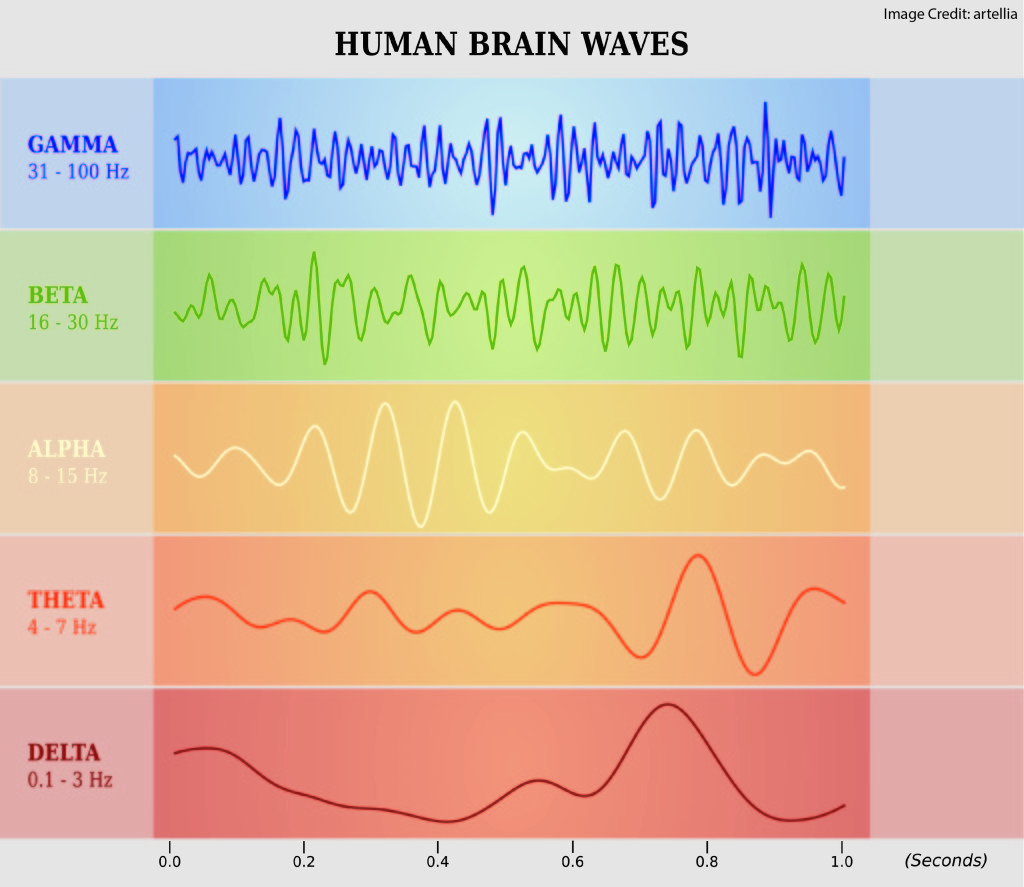
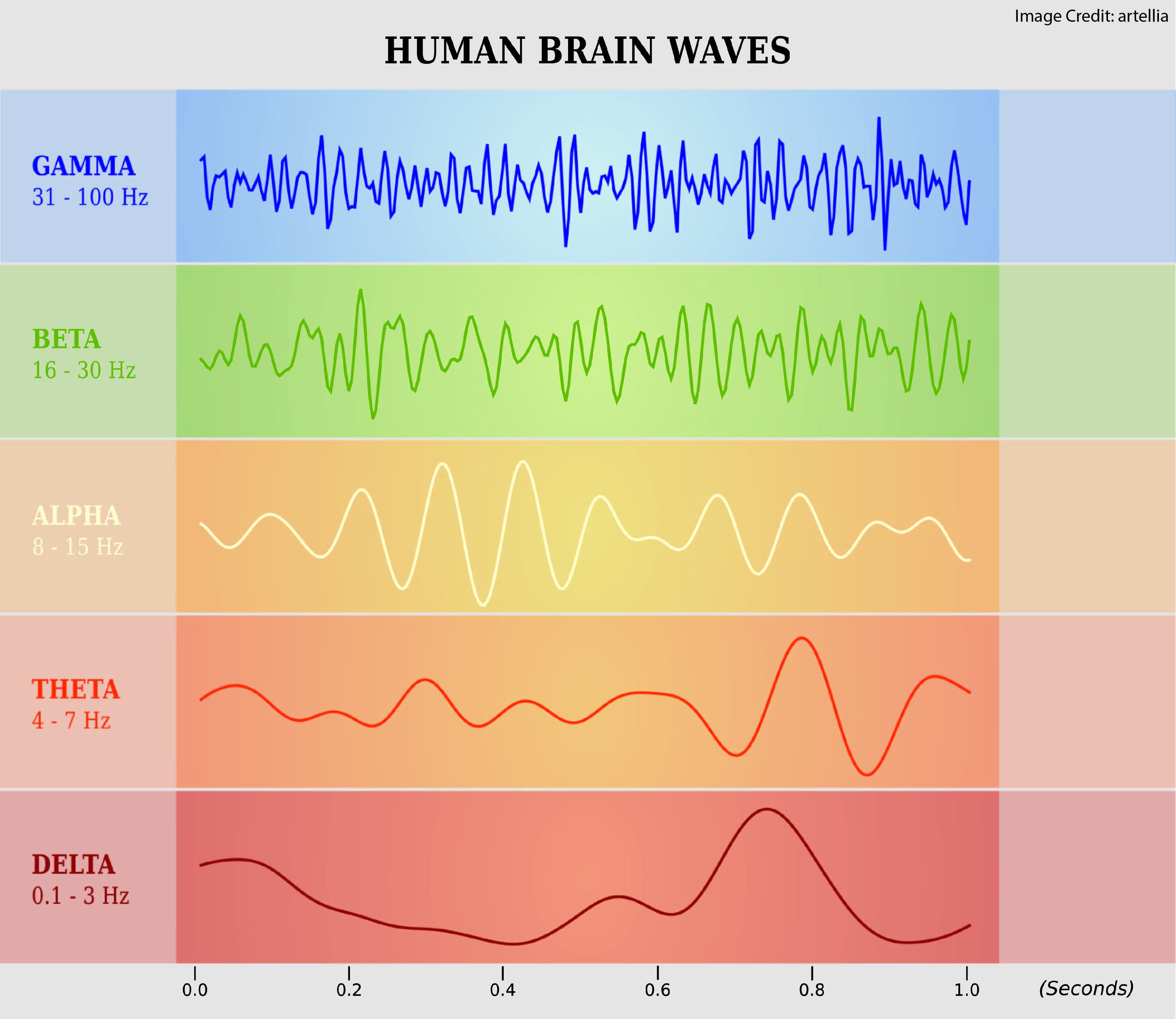
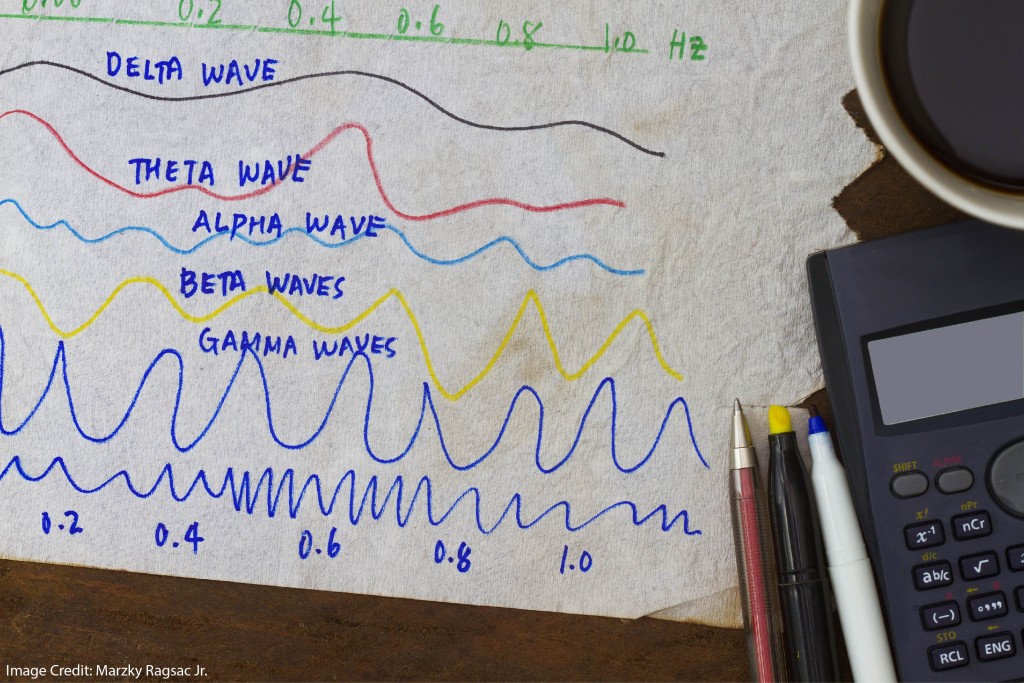
As you can see in the diagram above, gamma waves oscillate quite rapidly–up to 100 times per second–whereas delta waves oscillate slowly–fewer than 3 times per second.
(Wikicommons has a helpful visualization of different oscillation rates here.)
This article suggests that explicit memories show an increase in the alpha/beta range (10-30 Hz), whereas implicit memories produce an increase in theta waves (3-7 Hz).
In other words: explicit and implicit memories record different kinds of information, operate in different parts of the brain, and produce increases in different kinds of brain waves.
As of yet, there are no specific teaching implications to these research findings. However, they underline the point where this argument started: we can’t simply study a student’s memory system, because each student has so many (and so complex) memory systemS.
Little wonder, then, that teaching and learning can be so challenging. And, of course, so much fun.
 About Andrew Watson















![AdobeStock_124990522 [Converted]_Credit](https://braindevs.net/blog//wp-content/uploads/2017/12/AdobeStock_124990522-Converted_Credit.jpg)